Offers
Why a better offer beats better ads every single time
Short answerMedia buying can only change how efficiently you reach people. The offer decides whether reaching them is worth anything. A great media buyer on a weak offer buys expensive traffic to a thing nobody wants; an average buyer on a strong offer looks like a genius. That’s why offer work has more leverage than account work, almost always. You improve your offer before you touch anything else.
I want to be careful with this one, because it gets said constantly by people who use it as an excuse for lazy media buying. “It’s the offer” is a very convenient thing to say when your account is a mess.
So let me be precise about what I actually mean when I say improve your offer first.
The two things you can change
When something isn’t working, you have two broad levers. You can change how efficiently you reach people, or you can change what you’re reaching them with.
Media buying is the first lever. Better creative, better structure, better budget decisions, cleaner testing. Real skill, real money in it, and I’ve spent a decade on that side.
But it has a ceiling, and the ceiling is set by the offer. You can get very good at buying attention cheaply. You cannot make people want something they don’t want.
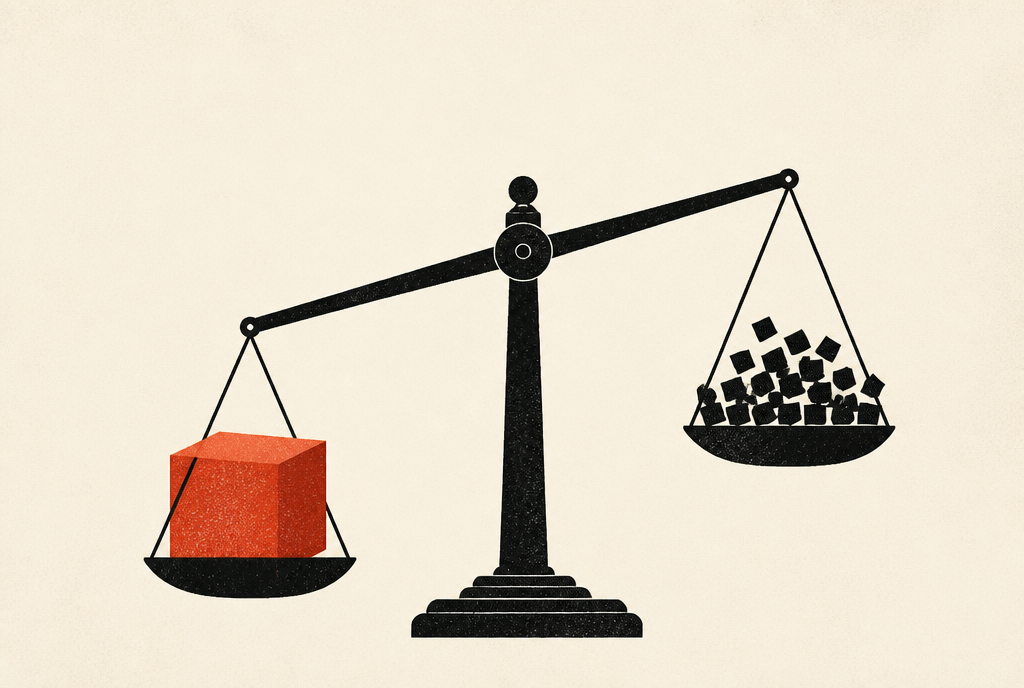
That’s the whole argument. Media buying is a multiplier. The offer is the number being multiplied. Getting very good at multiplying a small number is a lot of work for not much.
What “the offer is weak” actually means
This is where the phrase usually goes wrong, because people hear it as “your product is bad.” That’s rarely the issue. The product is often excellent.
A weak offer is usually one of a few specific things.
It’s aimed at the wrong moment. The product is right but you’re catching people at a point in their thinking where they don’t yet have the problem, or they’ve already solved it some other way. This is the most common one and it’s almost invisible from inside the business.
Or the mechanism isn’t clear. The buyer can’t tell how this works differently from the three things they already tried. Without that, price becomes the only comparison available, and you lose that comparison to someone cheaper.
Or the thing being asked for is too big for the trust that exists. You’re requesting a decision that would be reasonable from a warm referral and unreasonable from a stranger who met you eleven seconds ago.
None of those are product quality problems. They’re all structural, and they’re all fixable, so you can improve your offer without changing what you actually deliver.
How this shows up in an account
The tell is a campaign that works at low spend and dies when you push it.
At $50 a day, the delivery system only has to find the people who were already most of the way to buying. Those people exist in almost every market. You’ll get a respectable cost per acquisition and conclude you’ve found something.
Push to $200 and the system has to reach further out, into people who need actually persuading. If the offer only works on the pre-convinced, that’s where it falls apart. Every diagnosis you run on the ad account will come back clean, because nothing is wrong with the ad account.
People spend months there. Restructuring campaigns, rebuilding audiences, testing creative angles against a ceiling that isn’t made of media buying.
How to improve your offer
Before you touch the account, get honest about where your buyer is when they meet you, and whether what you’re asking for makes sense from that position.
Then look at your mechanism. Can you explain, in one sentence, how this works differently from the obvious alternative? Not why it’s better. How it’s different. If you can’t, your prospect definitely can’t, and they’re comparing on price.
Then look at the size of the ask. If the gap between “never heard of you” and “hand over money” is too wide, the fix usually isn’t more persuasion. It’s a smaller first step that’s genuinely useful on its own.
Anyways. The reason I push people toward this order is economic. When you improve your offer, results tend to move in multiples. Media buying changes tend to move them in percentages. Both matter. They just don’t deserve equal amounts of your week.
The honest exception
Sometimes the offer is fine and the account really is broken.
If your conversion rate on site is healthy, your repeat purchase is strong, and your traffic converts perfectly well from other sources but paid social is bleeding money, that’s a media buying problem and you should treat it as one.
The test I use: does this offer convert for anyone, anywhere, at any volume? If it converts through email and referrals and organic but not paid, the offer works and the problem is upstream of it. If it doesn’t convert anywhere, no ad account is going to save it.
Should I fix my offer or my ads first?
Check whether the offer converts through any channel at all. If it converts through email, referrals or organic but not paid, the offer is sound and the problem is in the media buying. If it converts nowhere, work on the offer first, because account changes cannot create demand that does not exist.
What does a weak offer actually look like?
Usually one of three things: it is aimed at the wrong moment in the buyer’s thinking, its mechanism is unclear so the buyer compares on price alone, or it asks for a decision too large for the trust that exists. None of these are product quality problems.
Why does my campaign work at low budget and fail at higher budget?
That is the classic signature of an offer that only converts the pre-convinced. At low spend the system reaches people who were nearly sold already. At higher spend it must persuade people who are not, and an offer without a clear mechanism fails there.
P.S. — The single fastest diagnostic is the one-sentence mechanism test. Say out loud how your thing works differently from the obvious alternative. If it takes you more than a sentence, that’s your week’s work, and it’s worth more than anything you’d do in Ads Manager.