Offers
How to price a low ticket offer so the math still works
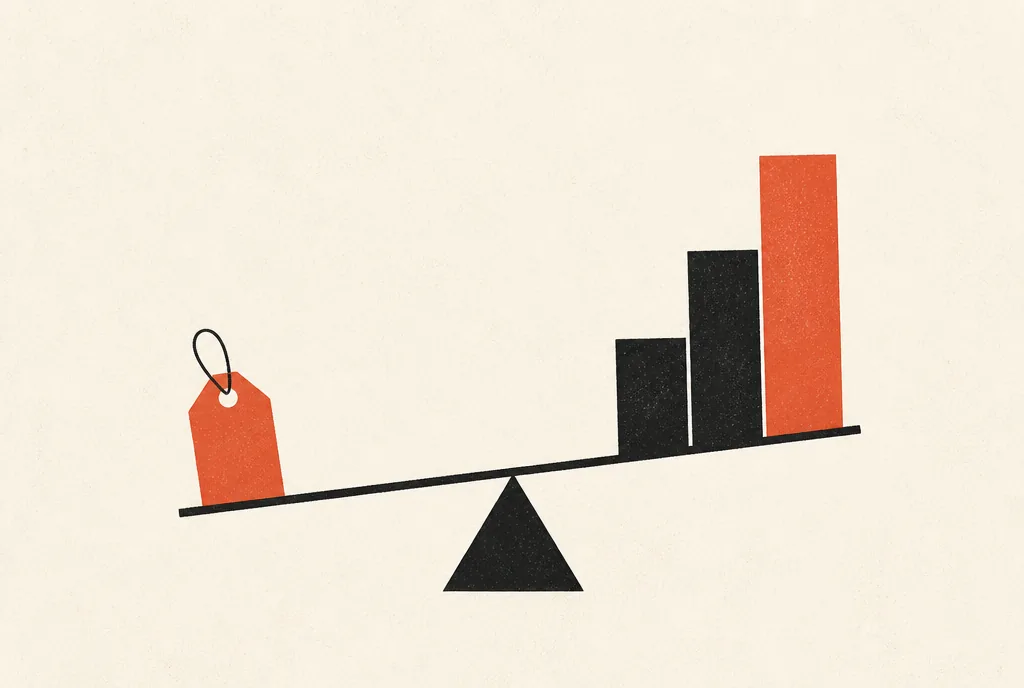
Short answerFor low ticket offer pricing, put the front end somewhere between $7 and $27, low enough to be an easy yes and high enough to pull in buyers instead of freebie seekers. Then stop judging it on its own price. Add up what the average buyer spends in the cart plus what the backend reliably brings in, subtract your costs, and that number is the most you can pay per customer.
Most people handle low ticket offer pricing by looking at what everyone else charges, picking a number that feels fair, and hoping the ads come in under it.
Then the ads come in at $38 on a $17 product and they decide low ticket doesn’t work.
It can work fine. You just have to do the math on the whole cart and the whole customer, not on the sticker price. Here’s the order I work through it in.
Step one: put the front end in the $7 to $27 band
When people ask me what price range to test, my answer has been the same for a while now. Seven to $27 is the sweet spot for low ticket offers, in pretty much any market. Go beyond that and the economics just don’t pan out for a cold traffic front end.
The low end of that band matters as much as the top. The point of a paid front end is that you acquire a customer, not a lead. Someone who pays you $7 has crossed the hardest line in marketing (they handed a stranger their card). A free opt-in hasn’t.
And whatever you put there shouldn’t try to deliver the whole transformation. Its job is to get someone past the first obstacle in their way. A $17 product that promises the entire four-year transformation isn’t believable, and people can feel that before they ever see the checkout. If you’re not sure where that line sits for your business, I wrote about building a front end that doesn’t cannibalize your backend.
Step two: work out what a buyer is actually worth
This is the step that decides whether “low ticket” is a strategy or a slow leak.
You need two numbers. Your target CPA is what you’d love to pay. Your breakeven CPA is the line between making and losing money, which is roughly your average order value plus whatever backend revenue reliably shows up, minus product costs and fees. Target is ambition. Breakeven is survival.
Here’s a made-up example to show the arithmetic. Say you sell a $17 front end. Three out of ten buyers add a $27 order bump, and 15% take a $67 upsell on the next page. Your average cart is $17 plus $8.10 plus $10.05, which is about $35. If your ads are bringing in buyers at $38, you’re not losing $21 per sale like the $17 price suggests. You’re a few dollars under on day one, before a single follow-up email has gone out.
One warning here. The purchase value your pixel reports is usually not your real order value, because the pixel tends to see the front end and maybe the bump while the backend happens somewhere it can’t track. Do this math from your payment processor, not from the ROAS column in Ads Manager.
Step three: build the cart so the bump finishes the job
The order bump is where low ticket offer pricing quietly wins or loses the math, and it’s usually treated as an afterthought.
There’s a very specific psychology to a bump. You only get a little block of text at checkout, and the thing that sells in that block is an extension that completes the front end. Something that helps them get better results with what they just bought, right away. A bump that’s a totally different topic (even a good one) won’t sell, because it doesn’t finish anything.
It also matters beyond its own revenue. The people who take the bump are the ones most likely to take the upsell on the next page, and most likely to come in on the backend later. So a weak bump doesn’t just cost you the bump. It costs you some of everything after it.
For reference, the benchmarks I’ve given for a low ticket funnel are five to eight, up to 15% of visitors buying the front end, 15 to 20% taking the first upsell, and about 10% on a second upsell or downsell. If you’re far below those, look at the offer on that step before you touch the price.
Step four: decide how long you’re willing to wait for the money
This is the part of low ticket offer pricing people skip, and it’s the one that decides whether you can scale.
I ran a dog training offer for about two years with a lot of my own money behind it (well over a hundred thousand dollars in ad spend). At one point the front end was a $3 book, with a $17 training guide as a one-click order bump, and a $67 video training series as the first upsell. The book and the bump converted like crazy. The $67 upsell, no matter what we did, would not convert at 10% on the spot.
So the money got made after the checkout. Email promos pushed people back to buy that video series (about seven days in was the average point where someone came back and bought it, because the nurture sequence was doing its job), and a monthly membership sat on top of that. Put all of it together and on average we came close to breaking even on cold traffic.
Which sounds unimpressive until you look at what it built. A list of several thousand people, over half of whom had bought the book, and at one point email alone was doing three to four thousand a month. Breakeven acquisition, then a list that kept paying.
I call that scaling into the negative. You know you’ll take a small loss up front for a while, because you’re buying relationships, not just sales. I’ve been willing to lose a little for one to two months to make a profit for one to two years.
But only do that on purpose. You need a real follow-up system, a backend that actually converts, and enough cash to float the gap. If any of those is missing, you need the cart itself to break even, and that means steps two and three have to work harder.
Step five: sanity-check the CPA against the market
Here’s a rule of thumb I’ve posted before. If it costs more than $25 to get a cold traffic sale on a low ticket product, either the offer isn’t good enough or the market is too small.
That’s not a law of physics. It’s a smoke alarm. When it goes off, look at the offer and the size of the market before you touch the ads. If you want benchmarks to compare against, I went through what a healthy cost per result looks like for a low ticket offer.
Also remember price points are pockets. Every market only has so many buyers at a given price. I had a client with a strong high-ticket backend whose $197 front end stopped working out of nowhere, even though he was spending over $1,000 a day and launching 40 to 50 new ads a week. He’d run out of people willing to pay $197 up front. We moved it to $97 and he told me it was the most sales he’d ever had.
Different price, different pocket of the lake. Sometimes low ticket offer pricing gets fixed by who you let in, not by how hard you push.
What to do this week
Open your payment processor and pull the last 30 days of front end buyers. Divide total revenue from those buyers (front end, bump, upsells and anything they bought within your follow-up window) by the number of buyers, then subtract fees and product costs. Write that number on a sticky note. That’s your breakeven CPA, and it’s the only number you should compare your ad costs against.
What is a good price for a low ticket offer?
For cold traffic, $7 to $27 is the range I’ve found works in almost any market. A paid front end in that range still filters for real buyers, which a free opt-in doesn’t. Above it, the economics usually stop working for a cold traffic front end. The exact number matters less than what the full cart and backend are worth per buyer.
Should a low ticket offer be profitable on the front end?
Not necessarily. Many profitable funnels roughly break even on the first purchase and make their money on order bumps, upsells and email afterwards. That’s fine if you have a real follow-up system and enough cash to wait. If you don’t, the cart itself needs to cover your ad cost.
How do I calculate breakeven CPA for a tripwire offer?
Take the total revenue from your front end buyers over a set window, including bumps, upsells and backend sales, and divide by the number of buyers. Subtract product costs and payment fees. That’s your breakeven cost per acquisition. Use your payment processor’s numbers, not the purchase value your pixel reports.
P.S. If you only fix one thing, fix the order bump. Make it the thing that helps someone get a result from the front end today. It’s usually the cheapest few dollars of average order value you’ll ever find.