Copywriting
Why writing to everyone is why nobody replies
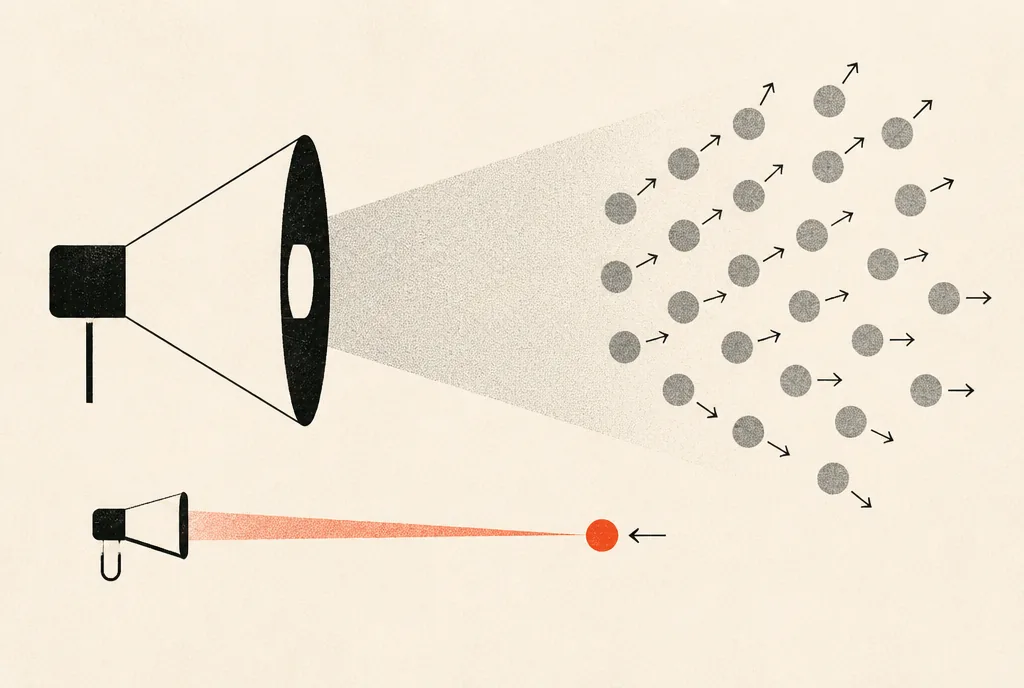
Short answerPeople decide in the first line or two whether a message is for them. Copy written to everyone gives nobody that signal, so everybody quietly decides it isn’t. On Facebook, vague copy also gives the algorithm nothing specific to match. In every ad or email, write copy for one person, at one moment, with one problem. Then cover the rest of your market with more pieces, not wider ones.
The instinct makes sense. You’ve got a market full of different people, you don’t want to leave anyone out, so you write the message wide enough to fit all of them.
“Business owners who want more leads.” “Anyone who wants to feel healthier.” “Whether you’re just starting out or already established…”
Nobody’s offended by that copy. Nobody replies to it either. And the bigger you try to make the circle, the quieter it gets.
People decide in two lines whether it’s for them
Think about what someone actually does when your ad or email lands in front of them. They read the first line or two, and they ask one question: does this match what I’m living through right now? If yes, they keep reading. If not, they’re gone.
Broad copy fails that question for everyone at once. It’s not wrong for anybody. It’s just not about anybody. The person with the exact problem you solve reads “business owners who want more leads” and doesn’t see themselves in it, because nobody thinks of themselves that way.
Compare that with what happens when you write copy for one person, describing one specific situation in the words they would use about it. Most people will scroll past, which is fine. The person it describes stops, because it feels like you’ve been reading their mail. That’s the only person you needed.
If you want the long version of why the specific line beats the clever one, I wrote about why specificity beats persuasion.
Broad copy teaches Facebook the wrong lesson
On Facebook there’s a second cost.
I target almost nothing in most accounts. Location, age, gender, and that’s about it. Which means the words and the image are doing the sorting. The way I understand delivery today, Facebook reads the context in your ad and goes looking for people whose lives match it.
So when the copy says something vague, you’re handing the machine a vague description of who to find. And whatever you ask Facebook for, it gives you more of. Ask for “anyone” and you’ll get a lot of anyone, clicking out of mild curiosity and never buying.
Specific copy is how you do targeting now. There’s more on that in why relatable ads convert worse than specific ones.
One person means one moment, too
Here’s where “write copy for one person” gets misunderstood. It isn’t just one type of person. It’s one person at one point in their timeline.
Take my own market. Someone about to run their first Facebook campaign and someone whose reliable winner just died after a good long run are both “business owners running ads”. They need completely different messages. The first wants to know where to start without wasting money. The second wants to know why the thing that worked stopped working.
Write one message to cover both and it’ll miss both. Same market, same product, two different moments.
That’s why my definition of a concept is so narrow: one person, with one big problem, at one point in the path to buying, in one emotional state, with one worldview. Every time you widen one of those, the copy gets softer. I go deeper on the timeline side in why your offer is aimed at the wrong moment.
Why the email to everyone gets no replies
Email makes this obvious, because replies are so easy to count.
A reply needs two things. The reader has to feel you were talking to them, and they have to have something they can actually answer. An email written for the whole list usually has neither. It reads like a broadcast, so it gets treated like one.
That’s how I build my own emails. They read like I’m talking to one of the crew about one thing. One question I get asked a lot. One problem a student ran into. One goal per email, and a call to action they can act on right now, whether that’s clicking or hitting reply with a specific answer. “Let me know your thoughts” isn’t something anybody answers.
If you picture one real reader while you write, the email changes shape on its own. You stop hedging for people who aren’t there.
When wider is actually right
Now the honest exception, because this idea breaks if you take it too far.
When I say write copy for one person, I don’t mean your whole account should talk to one kind of person. I’ve seen the opposite problem cost real money. An e-commerce client of mine sold custom tailored jeans for women, and her CPA had crept from $60 to $120 over about six months. The ads that used to crush barely brought in sales. When I looked, the problem was plain: all her ads were going to one specific sub-demographic. Once we fixed that, in about two days her CPA went from over $120 down into the $40s and $50s, and many days since have landed around $30.
So the rule is to write copy for one person per piece, and plenty of different people across the account. Going wide, not just deep, is how you find the other groups in your market. Every ad should still be specific. You just need more of them, aimed at different people.
What to do this week
Pull up your three best-performing ads or emails and your three worst. For each one, write a single sentence describing who it was written to and what moment they were in. If you can’t write that sentence, or it starts with “anyone who”, rewrite the first two lines of that piece for one specific person in one specific situation, and run it against the original.
Does narrowing my message shrink my audience on Facebook?
Not the way people fear. With broad targeting, your copy and image do the sorting, and specific messages tend to find the right people rather than fewer people. The risk is running only one narrow message. Cover your market with several specific concepts aimed at different groups instead of one vague one.
How do I get more replies to my marketing emails?
Write each email to one reader about one thing, and give them something easy and specific to answer. One goal per email, with a clear action, whether that’s a click or a reply with a particular answer. Broadcast-style emails that try to speak to the whole list rarely get responses because nobody feels addressed.
How do I know who to write to if my market is broad?
Pick one person at one moment for each piece: the problem they have, where they are on their timeline, and how they feel about it. Then write another piece for a different person and moment. A broad market is covered by many specific messages, not by one message stretched to fit.
P.S. A quick test for any headline or opening line: would the person it’s meant for say “that’s me”? If the most you’d get is “sure, I guess”, it’s written to everyone.